 PhilomobileBy Laurence Bouchet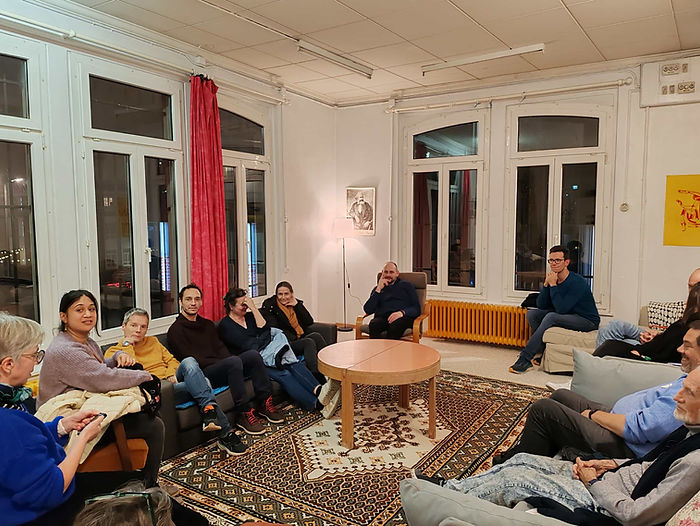
Here are some ideas put forward by participants in a philosophical practice workshop I led during the Night of Philosophy in Lausanne on 20 November 2025. At the end of this article, I explain the Socratic questioning method I use in these workshops.
The Ideas That Emerged in the Workshop
We don’t educate our emotions, but our relationship to them
One participant drew a distinction: we cannot educate an emotion in itself, because it arises instinctively, spontaneously and often unconsciously, running ahead of us in our own experience. Fear, anger or sadness impose themselves on us before we have time to anticipate or control them. On the other hand, educating our relationship to our emotions is within our power: learning to observe them from a distance, to name them precisely, to understand how they work, and to change how we react to them.
An emotion passes through us, but what we do with it engages our responsibility. For example, feeling anger is involuntary, but exploding verbally or physically is a choice, even if it seems inevitable at the time. Emotional education consists precisely in creating this space of freedom between the emotional stimulus and our behavioural response.
The obstacles to emotional intelligence
A fine analysis. I then suggested that the group examine the obstacles to this education, and here are the ideas the participants proposed.
The obstacles are many. First, the difficulty of identifying what we feel: emotions are often confused and ambivalent, mixing sadness and anger, for example, or joy and anxiety. We also lack a precise emotional vocabulary, settling for vague terms like “I feel bad” or “I’m stressed” without really understanding the exact nature of our inner state. Next, defence mechanisms make it harder to access our emotions: some people repress them out of shame (crying would be a sign of weakness), others cut themselves off from them because their violence is unbearable, and still others project them onto others (“he’s the one getting on my nerves” rather than “I’m irritated”). Finally, our traditional education has generally never taught us to examine our emotions, favouring the acquisition of intellectual knowledge instead.
Developing bodily and cognitive awareness
Several paths were suggested for making progress in this education. The first is to notice bodily signals: an emotion first shows itself physically (heat, tightness, trembling, tension). Learning to locate these sensations in the body makes it possible to become aware of the emotion before it overflows. The second path invites us to question our interpretations: often it is not the situation itself that triggers the emotion, but our reading of it. Anger frequently arises from a sense of injustice — but is that sense always legitimate? Examining our spontaneous judgements can defuse excessive reactions. The third path, inspired by the Stoics, is to change our representations: if I consider a late bus a disaster, I get angry; if I see it as a chance to breathe, my emotion changes.
Tools for transforming our reactions
The practical tools for educating this relationship to our emotions are varied. Conscious breathing creates a pause between emotion and reaction. Analysis and questioning help clarify what we feel and step back from it.
An often-neglected point: even positive emotions deserve to be educated. Joy can be repressed (out of fear of judgement, or from a habit of not allowing ourselves pleasure), or on the contrary lived compulsively (a constant search for excitement). Learning to fully welcome a simple joy, without fleeing it or forcing it, is also part of this education.
Patience and maturation
Experience shows that some emotional changes happen unconsciously, with time and maturity: a childhood fear disappears without our knowing why. But other transformations require conscious, regular work. It is a long-term apprenticeship, made of experiments, failures and gradual adjustments. The aim is not to become insensitive or perfectly self-controlled, but to develop a more conscious and freer relationship with what we feel.
This gradually transforms the way we inhabit our inner life and our relationships with others: instead of emotional automatism, we open up a space of freedom.
The Socratic Questioning Method
Philosophical practice: when thinking becomes embodied
Most of the time, philosophizing seems to consist in handling concepts, quoting authors and commenting on texts with a certain intellectual elegance. This way of approaching philosophy gives us the feeling that we understand, that we have mastered and grasped something fundamental about ourselves and the world. Yet this feeling of understanding often rests on an illusion: believing that we are really thinking because we are talking about thinking, when genuine thought only arises once we agree to be tested and transformed by the experience of thinking. The very exercise of thinking involves working on oneself, a transformation.
Reading a treatise on swimming doesn’t teach you to swim
Exercising thought is like swimming. You can read every possible treatise on the front crawl, memorize the ideal arm position, the angle at which the hand enters the water, coordinated breathing, and imagine you have mastered the technique. But when you get into the water — when the resistance of the water, the weight of your body, ragged breathing and disorientation come into play — the truth appears: you know nothing until you have faced the real experience. Theory created a fiction of competence, an abstract and attractive knowledge, entirely disconnected from practice.
Philosophy suffers from the same ailment. We can know Spinoza, understand the affects, recite the Stoic distinctions between judgements and events, and believe this knowledge is enough to transform us. But intellectual understanding changes nothing until it is put to the test of experience and of emotions — which cannot be disciplined or tamed by theory.
The philosophy workshop, a living laboratory
This is precisely where philosophical practice comes into its own. The workshop becomes a living laboratory in which thought stops being a disembodied exercise and is tested in the thickness of presence, speech and the body. Emotions arise immediately, well before ideas. In the workshop I recently led in Lausanne on the question “Can we educate our emotions?”, this dimension was obvious. Putting myself in Socrates’ shoes, I gave strict instructions, asked for clarification, asked direct questions, pointed out contradictions, recalled the framework and interrupted to come back to the subject. That was enough to bring out the real material of philosophical work: irritation, frustration, embarrassment, the need to justify oneself, the wish for approval, the fear of being exposed, sometimes even shame or anger.
Emotions are not interference, but the material of the work
These reactions are not accidents along the way. They are neither methodological drift nor parasitic disturbances. On the contrary, they are the very heart of what needs to be worked on. As long as we stay in theory, we tell ourselves a convenient story: we believe we are rational, detached and lucid, when we simply haven’t been touched where questioning makes our certainties waver. A remark, a request for clarification, or simply insisting that someone answer the question asked is enough to reveal what theories conceal: a difficulty in thinking.
We then react instead of reflecting. And these reactions, once observed, become genuine revealers of our innermost representations. Someone convinced they have a critical mind may suddenly discover, in a workshop, that they cannot even openly own a simple disagreement: theory collapses as soon as practice begins.
Making things visible
The workshop makes visible what we constantly avoid in ordinary life: the difficulty of taking a position, the temptation to dodge the question, the need to be well regarded, the fear of displeasing, the defensive reaction as soon as a contradiction is pointed out, the impossibility of admitting that we don’t know. All of this surfaces and comes into the open.
The philosophical space thus becomes a miniature of reality — not by reproducing it, but by condensing it: in a few minutes, it makes perceptible emotional mechanisms we sometimes ignore for years. In the workshop, reality stops being diffuse; it becomes legible.
We then discover that the obstacles to thinking are not conceptual but emotional. The point is therefore not to accumulate knowledge about emotions, but to observe what, within us, stands in the way of clarity.
Discomfort as a condition of lucidity
This discomfort is not a failure but a condition. Without friction, nothing becomes visible. Without that moment when we are touched and feel destabilized, there is nothing to grab hold of. And without something to grab hold of, no transformation is possible. The workshop does not seek to spare people; it seeks to make them lucid. This is what makes it radically different from purely academic philosophy. Concepts are no longer intellectual ornaments, but tools for reading what is happening within us at the very moment it happens. Thinking becomes a living gesture, not a theoretical construction.
To philosophize is to agree to get into the water
Discomfort becomes a path to lucidity. Emotion stops being an obstacle and becomes a revealer. Philosophizing then means agreeing to get into the water, to face the element, to feel the resistance, the loss of balance, the gasps for air — and to understand that we only think by letting ourselves be touched. Philosophical practice rests precisely on this: a demand for embodiment, a willingness to be tested, a desire to see what is at stake in the reaction rather than in controlled discourse.
It does not aim to produce impeccable ideas, but more lucid human beings. It does not seek to stifle or hide emotions, but to learn to think through them. Philosophizing then becomes an existential experience, a work on oneself through trial, and not an accumulation of theoretical knowledge. In this sense, thought stops being mere discourse and becomes an experience that lastingly changes and strengthens our way of being in the world.
 Reflections
 Reflections
 Reflections
CONTINUE THE DIALOGUE
Your reflections on this text
These lines make no claim to definitive truth: they are a proposal to discuss, extend or contradict. Your objections, questions and hypotheses are welcome.