 PhilomobileBy Laurence Bouchet
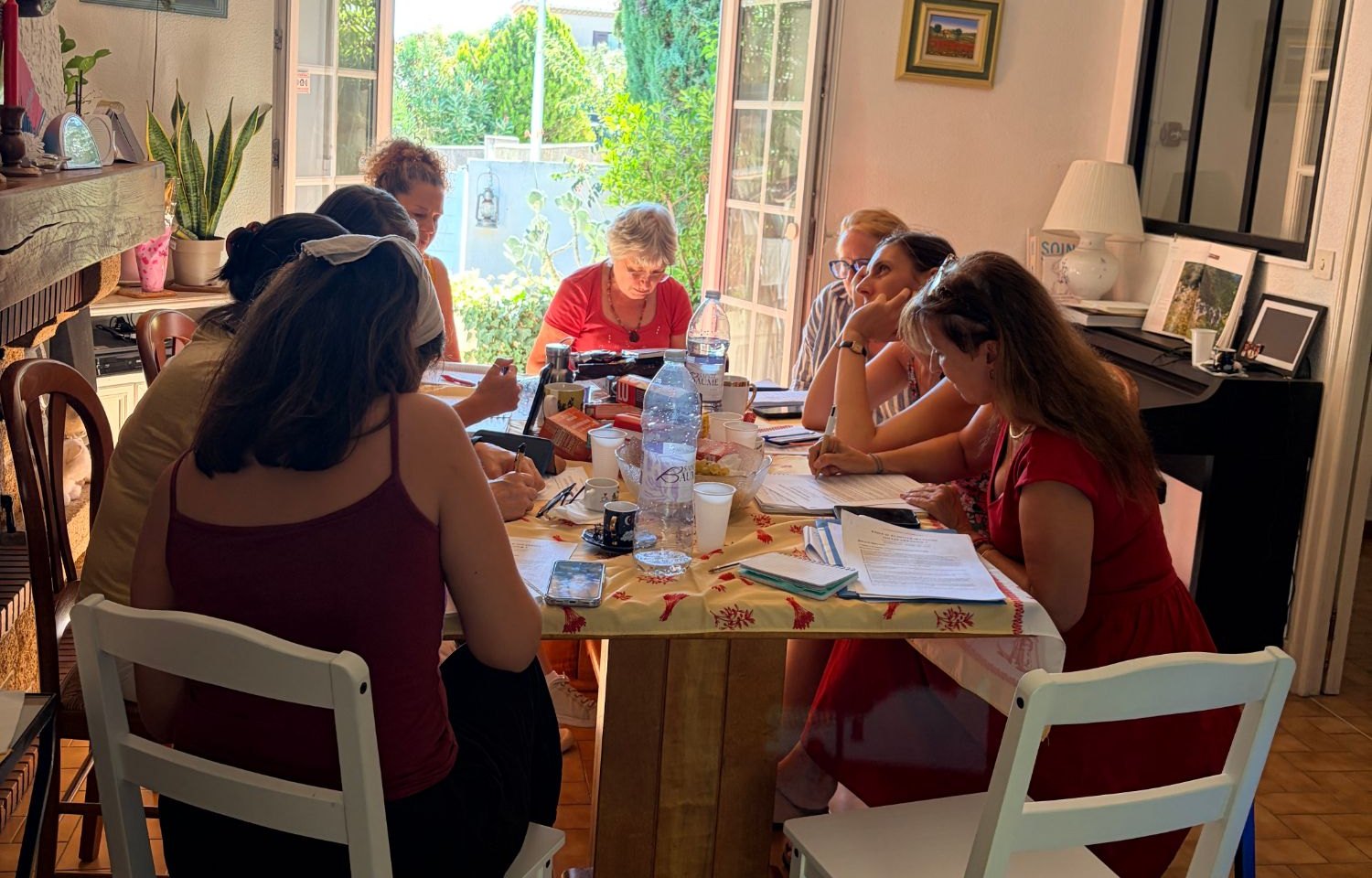
That day, I opened the philosophy workshop for adults with a warning: taking part in such a space means agreeing to see yourself, sometimes in an uncomfortable light. It is not just about discussing abstract, theoretical ideas, but about daring to face yourself, your contradictions, and what an outside eye can reveal.
So I set a demanding framework for my philosophy workshops: don’t rush to speak; think; raise your hand before speaking so as to take time to reflect; listen to others; give up your personal “agenda” — that is, the irresistible urge to bring the discussion back to yourself. These rules aim to bring about a genuinely philosophical posture: attention, patience, availability.
And yesterday, as sometimes happens, a tension arose in the very first minutes with a participant who felt judged because I pointed out that she had not followed the rule of the game. From my point of view, it was interesting to observe, because it revealed a certain haste in her — a haste she was perhaps not very aware of, but which she could now take the time to examine. Unfortunately, she did not see it that way. She considered it an inappropriate judgement on my part, nothing more. She felt I was passing a moralizing judgement on her, which was unacceptable in her eyes. In a way, she judged my judgement — and my person along with it.
It is true that I was observing and naming what I saw, but it was not meant to belittle or condemn. Yet that is the interpretation she held on to. It is also true that a common opinion in our time rejects judgement. We often hear that we mustn’t judge.
The consequence is that we too often feel locked into a judgement, when that may not be the concern of the person observing us at all. We can also choose to feel enlightened by the observation, because it is not easy to observe ourselves, and the other person, with their distance, can help us do so.
That moment became a living example of the workshop’s topic: why are we sometimes at odds with what we know to be good for us? Why do we resist frameworks we have ourselves chosen or accepted? Why do we say we want to philosophize while rejecting what that involves?
The question resonated with everyone’s experience. The participants then offered common examples of inconsistency between what we say and what we do: anti-capitalist activists who consume the products of capitalism; politicians or trade unionists who champion feminism while being guilty of domestic violence; parents who advocate a screen-free upbringing but end up switching on the TV for some peace; or committed environmentalists who still take the car or the plane for comfort.
So Why Don’t We Live Up to the Values We Claim?
Faced with these contradictions, several hypotheses emerged:
1. A hierarchy of values: Patrick suggested that we are often torn between competing values. We know what we “should” do, but another priority takes over. It isn’t necessarily hypocrisy, but unconscious trade-offs.
2. Looking for excuses: we tell ourselves stories to justify the gap between our words and our actions. These justifications spare us the shame or guilt of inconsistency. We are not consistent because we want to believe we live up to our values, which is flattering — but reality is sometimes quite different.
3. Frustration: being consistent often means giving up a pleasure, a comfort or a habit. It means making an effort on ourselves. That requires a capacity to tolerate frustration that we don’t always have.
4. The split between thought and action: Cyril, one of the participants, suggested that thought and action are two distinct spheres governed by different logics. To think is to dream ourselves; to act is to face reality. We can have very high ideals and still give in when it comes to action, out of tiredness or weakness.
5. The weight of the group: other people’s gaze strongly influences our choices. It is sometimes harder to stand by our values in front of a group that doesn’t share them — hence compromises, even surrender.
6. A lack of humility: Ghislaine suggested that admitting we are acting badly, or not living up to what we say, means colliding with an idealized image of ourselves. That takes lucidity, but also a certain kindness towards ourselves, without which shame paralyses us.
The essential role of the other: Dominique added that, alone, it is hard to see ourselves accurately. It is often through someone else’s feedback — kind or unsettling — that we reach a kind of truth about ourselves. The workshop then becomes a collective mirror, sometimes uncomfortable, but salutary.
An important distinction was made in the discussion: there are ordinary inconsistencies, understandable and human, and others that are more problematic, almost toxic. The first stem from our natural limits and everyday weaknesses. The second concern fundamental moral values and often reveal a process of denial.
The more moralizing someone’s discourse, the more we may suspect a need to hide a dark side of themselves. This phenomenon of “projection” consists in attributing to others what we refuse to see in ourselves. Simone Weil saw in this projection one of the main sources of wickedness: for her, the wicked act is a transfer onto others of the degradation we carry within ourselves.
The workshop ended with the idea that aiming for consistency is an endless task. We never fully achieve it, but it is an effort worth making. The point is not to become perfect, but to cultivate an honest lucidity: acknowledging our lapses, understanding them, questioning them. This lucidity involves accepting our contradictions, being patient with our limits, and being open to the kind gaze of others, who can help us see ourselves more accurately. For it is in this calm — and why not amused — confrontation with the truth about ourselves that a more authentic consistency begins.
 Reflections
 Reflections
 Reflections
CONTINUE THE DIALOGUE
Your reflections on this text
These lines make no claim to definitive truth: they are a proposal to discuss, extend or contradict. Your objections, questions and hypotheses are welcome.