 PhilomobileBy Laurence Bouchet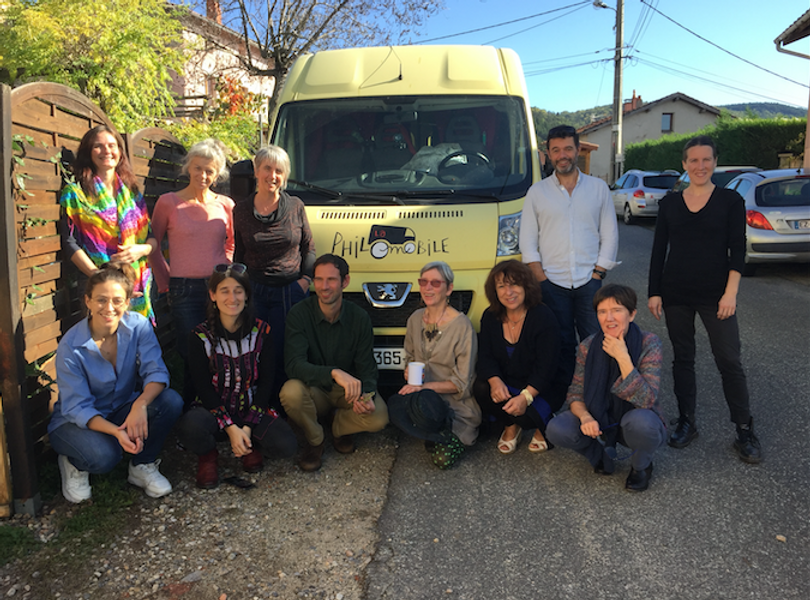
Working on attitudes is what most unsettles people in philosophical practice, because it is often uncomfortable, and as a philosopher-in-Socrates’-shoes it doesn’t always win you friends… and yet it seems essential to me.
Philosophizing is not just expressing yourself; it is not even simply thinking. It is thinking about what you think — stepping back from your ideas and from yourself in order to observe, question and even criticize what you think and do at a given moment.
It means agreeing to take a critical look, because we will win every time: we will become both more flexible and firmer. More flexible, because we will be able to examine things from different points of view; firmer, because after examination we will know why we choose the idea and the commitment we choose.
But this choice requires TIME, PATIENCE, HUMILITY and CONFIDENCE.
TIME AND PATIENCE to listen to different points of view without clinging to our own.
HUMILITY, because we must admit that we don’t know, that we don’t have the answer straight away, and that even if we want to appear important or interesting, we may look foolish for not knowing what to think, or for trying out an idea we may later criticize for its weakness.
CONFIDENCE to answer the person asking the questions. Confidence to understand that even if these questions may put us in difficulty to some extent (because they invite us to think differently, to commit to an answer, to become clear and therefore to expose ourselves to others’ criticism), they still make sense.
Confidence, then, to know that even if we are put in difficulty, this is not a fight in which we risk losing and must win; it is not about dodging traps and obscure manipulations, as some very suspicious people sometimes imagine. A different game is on offer in a philosophical reflection workshop: that of starting to think with nothing to prove. A difficult posture, since it means being both committed and detached.
“This isn’t philosophy, it’s psychology,” some people sometimes object, as if psychology were something disgusting. It is true that since Socrates and the philosophers of antiquity, philosophy has abandoned the introspective work of “know thyself”.
And yet how can we think if we rush to react without taking time to reflect, if we want to prove we are intelligent, if we are haunted by the fear of looking stupid, if we try to charm with fine language, if we take refuge in confusion so as not to expose ourselves to criticism, if we don’t take a position to propose an idea, if we listen neither to others nor to ourselves, if we don’t accept that others may disagree, if we systematically disagree without even considering what the other person says?
These are all very common attitudes that stand in the way of thinking and that characterize, more or less strongly, what we do — the postures we all tend to lock ourselves into as long as we are not aware of them. Philosophical practice invites us to become aware of them.
But instead of moping and feeling guilty about these “human, all too human” behaviours, instead of moralizing, we can find it amusing to outwit them in others as much as in ourselves. For that, a little humour and self-mockery help, along with a rather playful, light attitude — even an aesthetic eye on our attitudes. Then philosophical practice, even if it shakes us up a little, also becomes a game: a serious game in which thought comes alive between participants who question and surprise one another with their ideas.
 Reflections
 Reflections
 Reflections
CONTINUE THE DIALOGUE
Your reflections on this text
These lines make no claim to definitive truth: they are a proposal to discuss, extend or contradict. Your objections, questions and hypotheses are welcome.