 PhilomobileBy Laurence Bouchet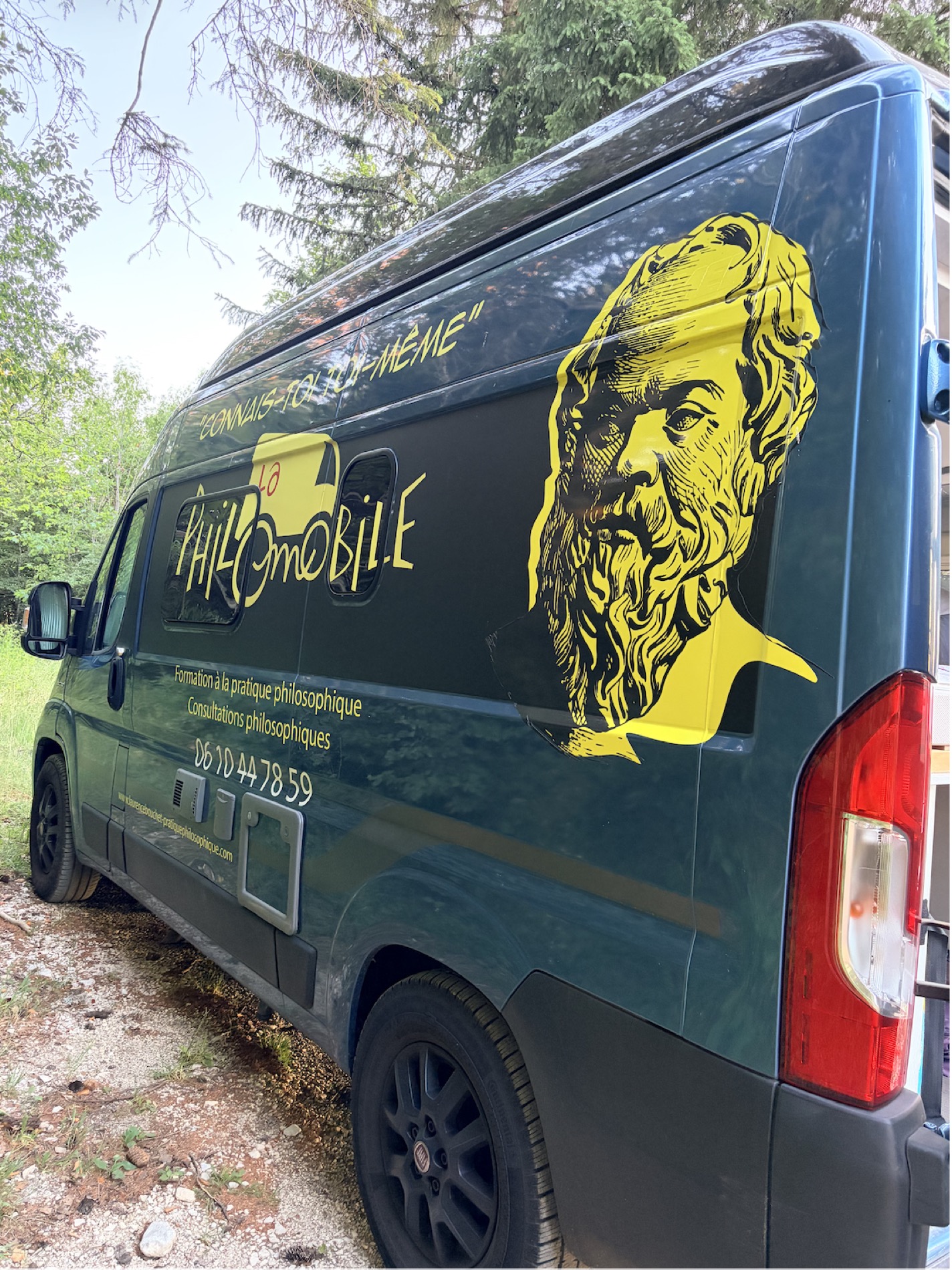
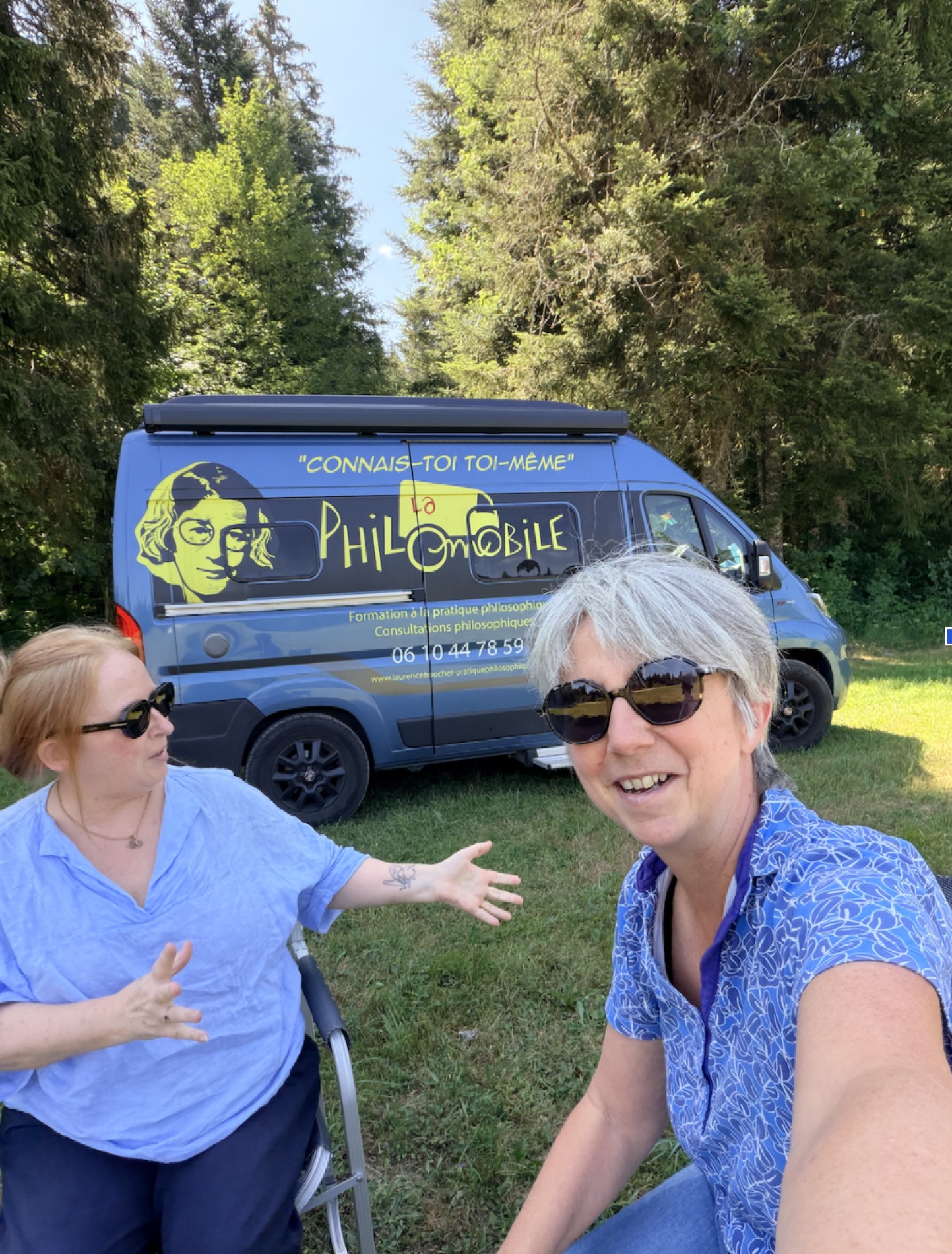
This summer, the Philomobile took to the road again. But this time, it wasn’t just about driving somewhere to run consultations or workshops. I wanted to try a new kind of philosophical journey: setting off with a few people, driving, living and thinking together, then meeting citizens in towns, villages and passing places.
Catalina, Corinne and Wei each shared this adventure with me in turn. Wei is a practicing philosopher in China. She doesn’t speak French, but she speaks English — her presence gave some encounters an unexpected cross-cultural dimension.
We crossed the Franche-Comté region, stayed by Lake Joux, and carried on to Lausanne. Everywhere, the principle was the same: set up in a public space and offer passers-by a free invitation to talk and philosophize with us.
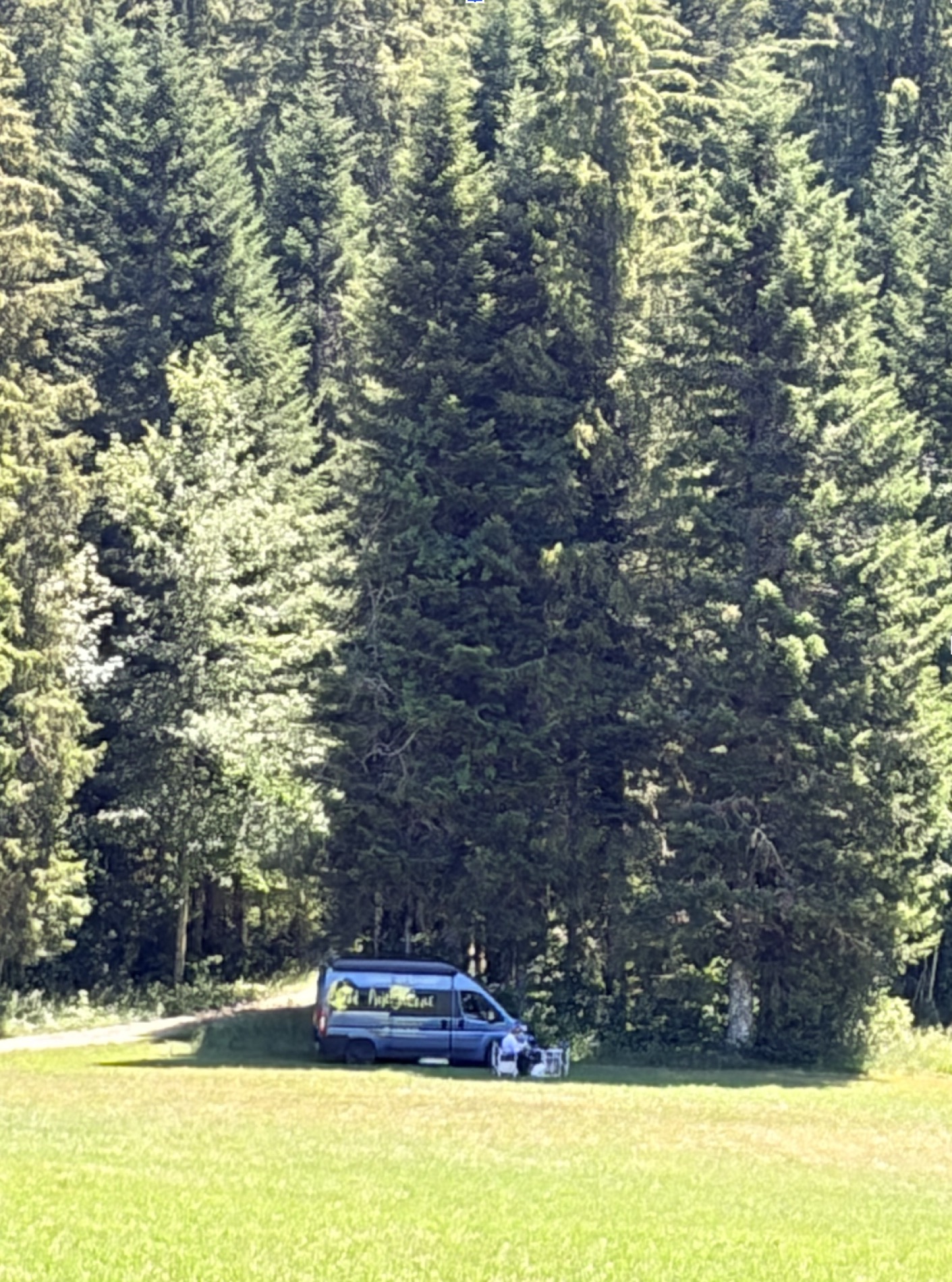
Traveling Differently
A Philomobile journey is neither a holiday nor a philosophy course in the usual sense. We weren’t trying to rack up visits, or to stay among people already convinced of the value of philosophical practice.
The journey itself was part of the experience.
We talked while driving, in front of mountains, by lakes, or during the ordinary moments of daily life. We read and discussed philosophers, but above all we examined our own ways of living. Whatever we ran into along the way became something to think with.
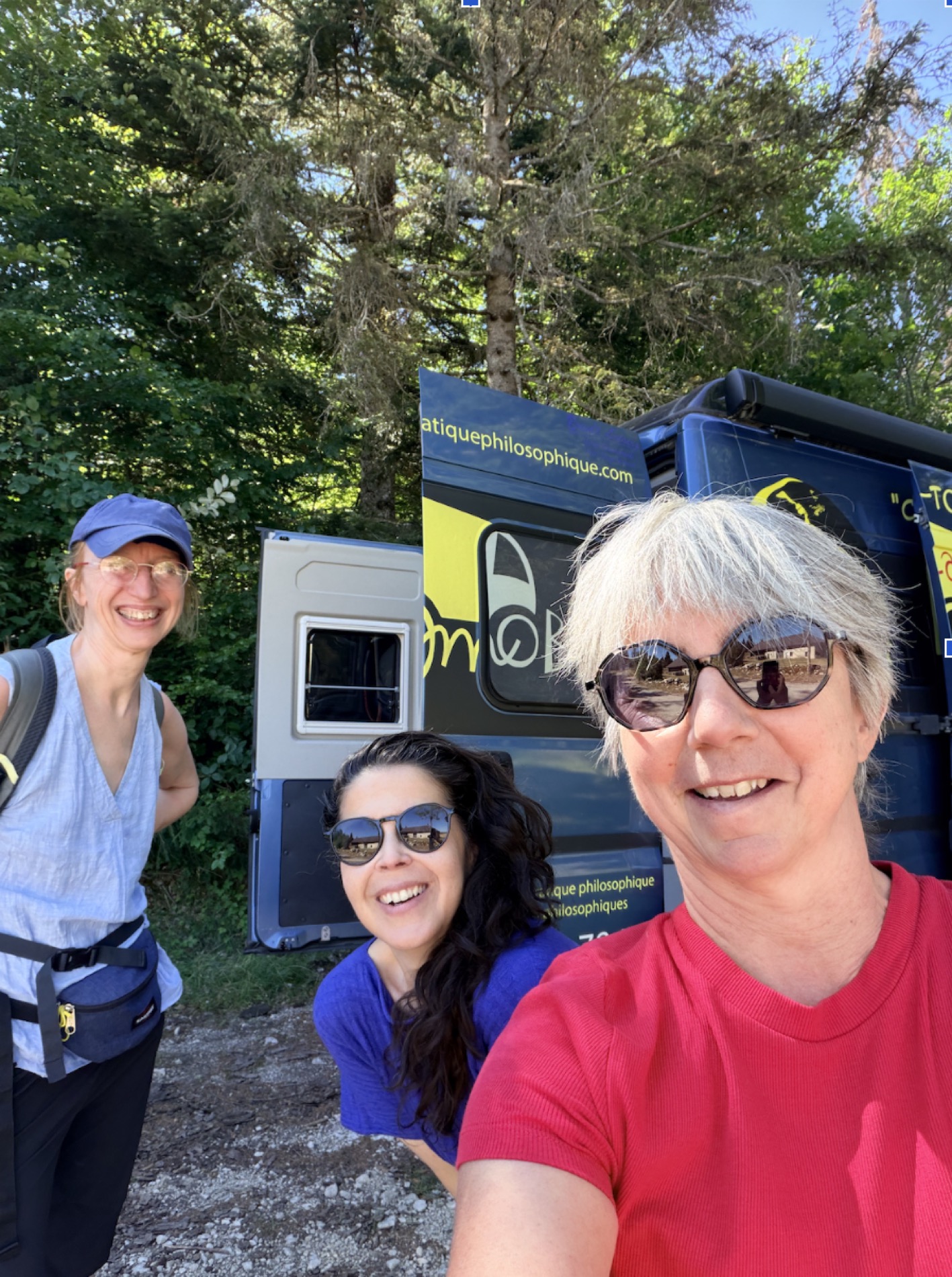
With Catalina, we talked a great deal about the ancient Cynic philosophers, Diogenes above all. His legacy is often reduced to provocation. But his ambition ran deeper: to depend as little as possible on external circumstances, and to test the conventions we obey without ever asking why.
Catalina put into words a dilemma she knew well: how do you stay true to what you believe you should do without becoming rigid? A third way emerged as we talked: becoming more playful, more experimental — trying out different ways of living instead of rushing to find the right one.
That’s part of what traveling is too: moving enough that our habits stop seeming, for a moment, self-evident.
Showing Up With No Title and No Ready-Made Audience
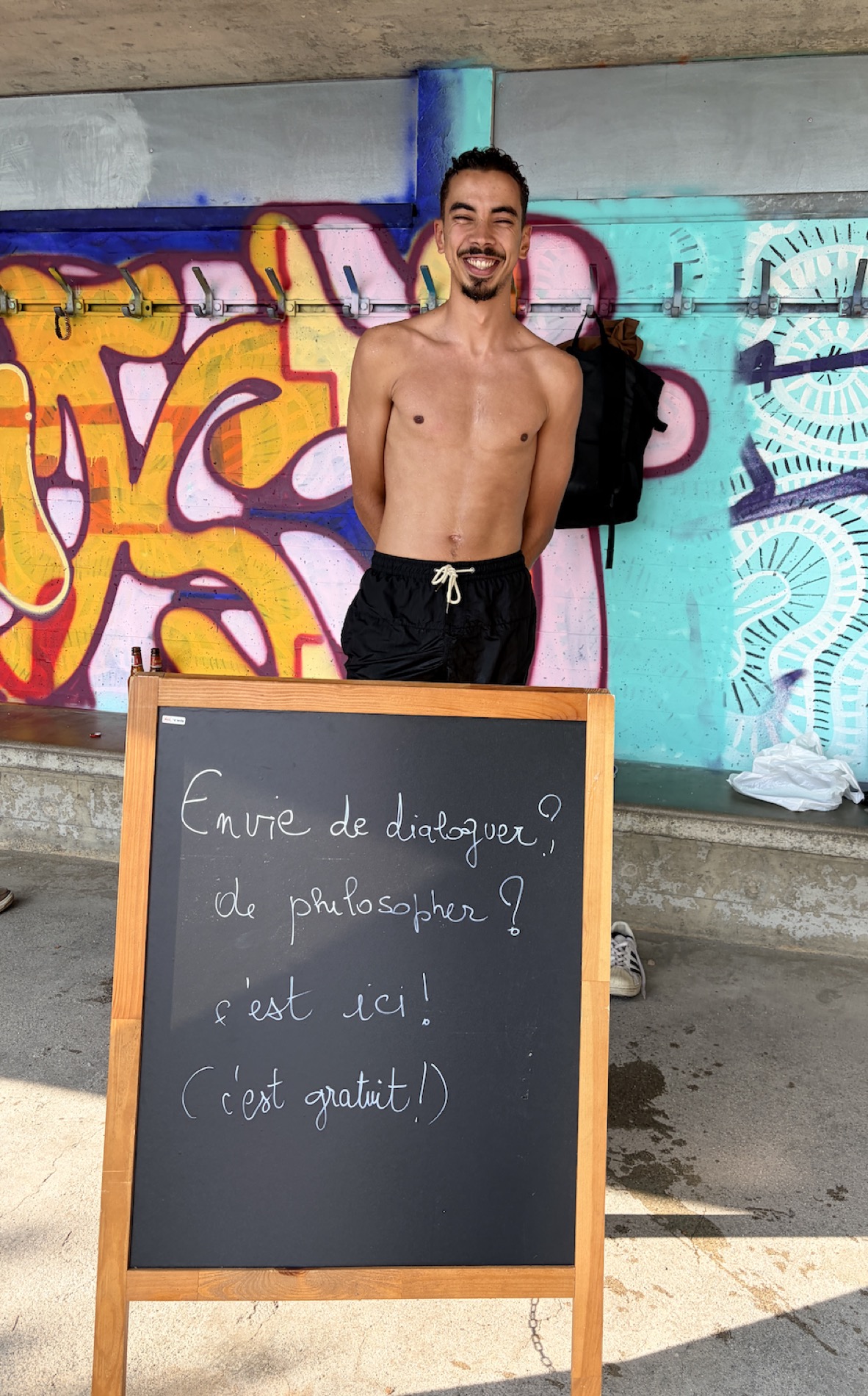
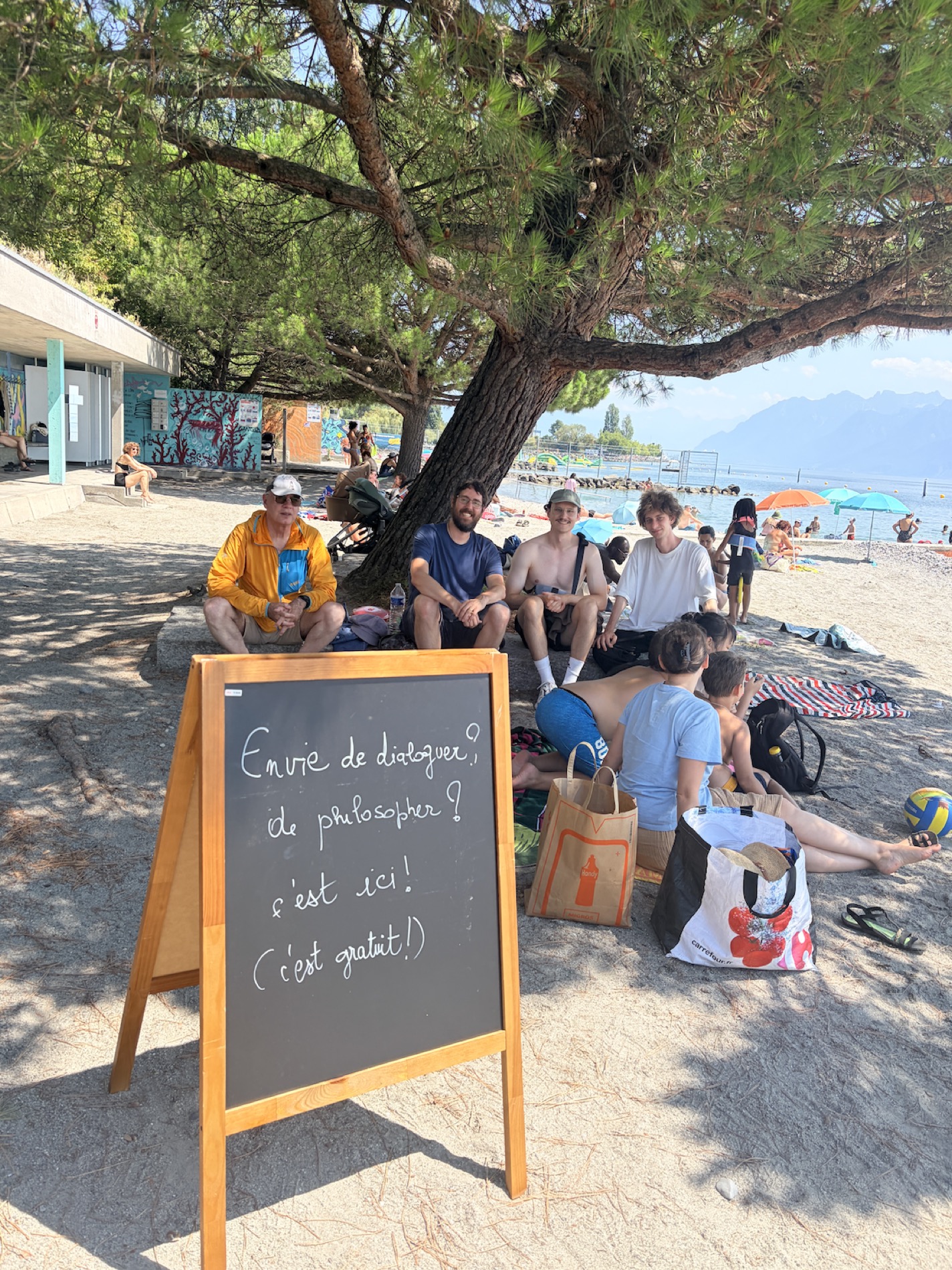
To philosophize in the city, we would set up a sign:
“Feel like talking, philosophizing? Right here, and it’s free.”
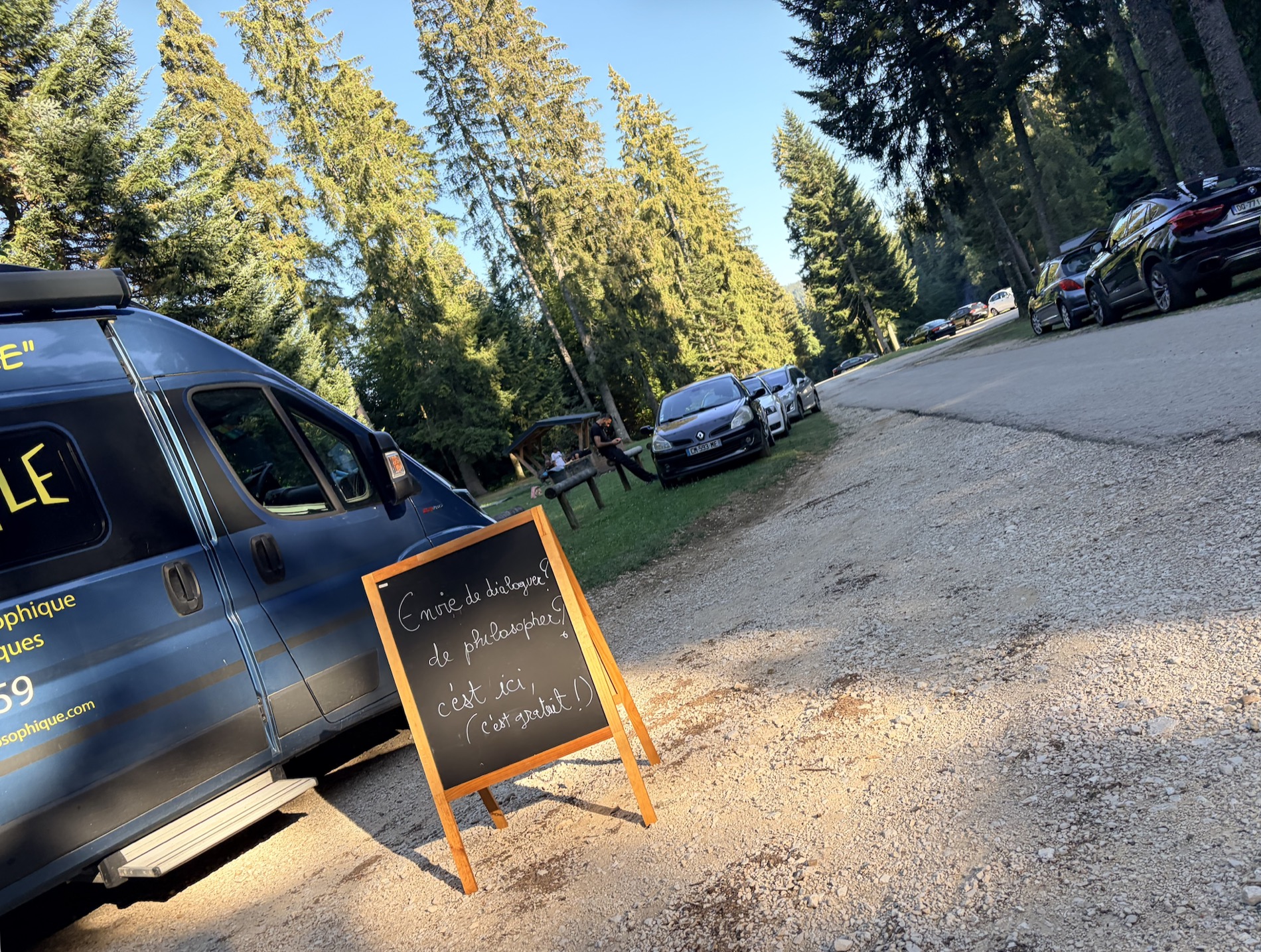
Then the unexpected would begin.
Some people stopped, intrigued. A few declined politely; others walked past without looking up, or claimed to be in a hurry before calmly continuing their stroll.
Philosophizing in public means first accepting this indifference and these refusals. Unlike a lecturer, we had no stage, no institution, no audience already inclined to listen. We had to go toward others without knowing how our offer would land.
That situation was already a philosophical exercise in itself. Could we want dialogue without begging for approval? Keep believing in the value of what we were doing, even when no one stopped?
Otherness stopped being an abstract concept. It became rough, unpredictable, sometimes uncomfortable.
By Lake Joux: “Stand Out of My Sunlight”
By Lake Joux, with Corinne, we met Solal, a chimney-sweep apprentice, and Amaric, a forestry apprentice.
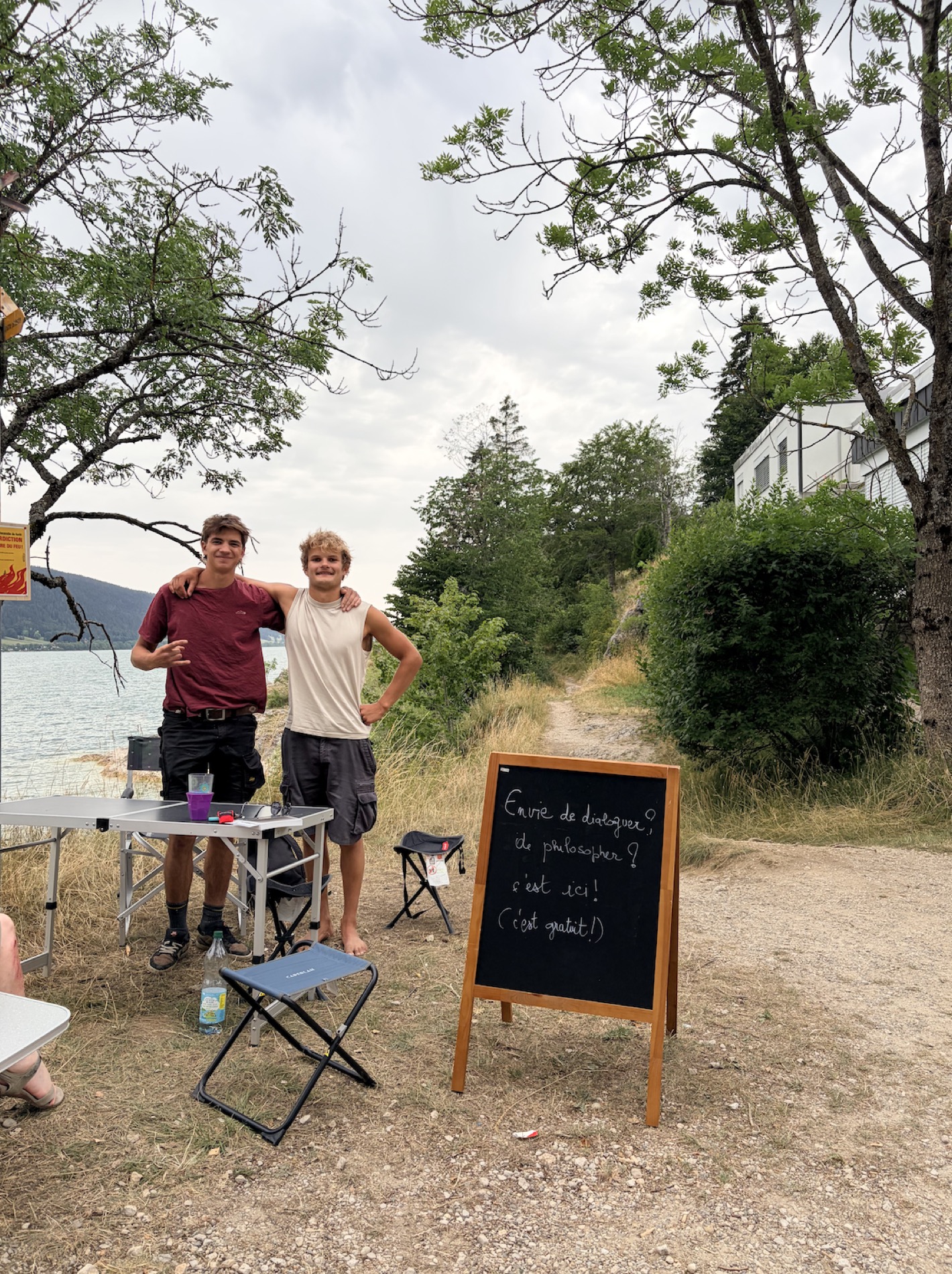
To get the conversation going, I told them the story of Diogenes. When Alexander the Great asked if there was anything he could do for him, the philosopher simply replied: “Stand out of my sunlight.”
The line made them smile. When you’re an apprentice, you often have to bend to the codes of the trade, the job site, the boss, the adults who supposedly know better. Diogenes’ words, addressed without flinching to one of the most powerful men of his time, felt liberating to them.
Solal admitted he couldn’t stand being given orders. And yet, when asked to do something, he’d usually say yes… and then not do it. I teased him with a phrase: “You’re a soft rebel!” He recognized himself in it and laughed.
We went on to distinguish several ways of rebelling: head-on opposition, silent resistance that risks making us unreliable, and a rarer kind of rebellion that doesn’t try to defeat the other person but to shift how they see things.
With Amaric, the conversation turned to family. He sometimes felt he was disappointing his parents, without them ever really saying so. The feeling was built from remarks, silences and interpretations accumulated over time.
We discovered that the hardest stranger to meet isn’t always someone from another country. Sometimes it’s the person we think we’ve always known. Familiarity gives us the illusion of knowing what the people close to us think. Truly meeting one’s own family would mean giving up that false transparency and daring to ask the questions we assumed were pointless.
In Lausanne, an Open-Air Philosophy Lab
With Wei, we set up for two days on Vidy beach, in Lausanne. The spot was both busy and cosmopolitan. Around us, people were swimming, resting, chatting or playing chess. Maël, also a practicing philosopher and a specialist in Stoicism, joined us.
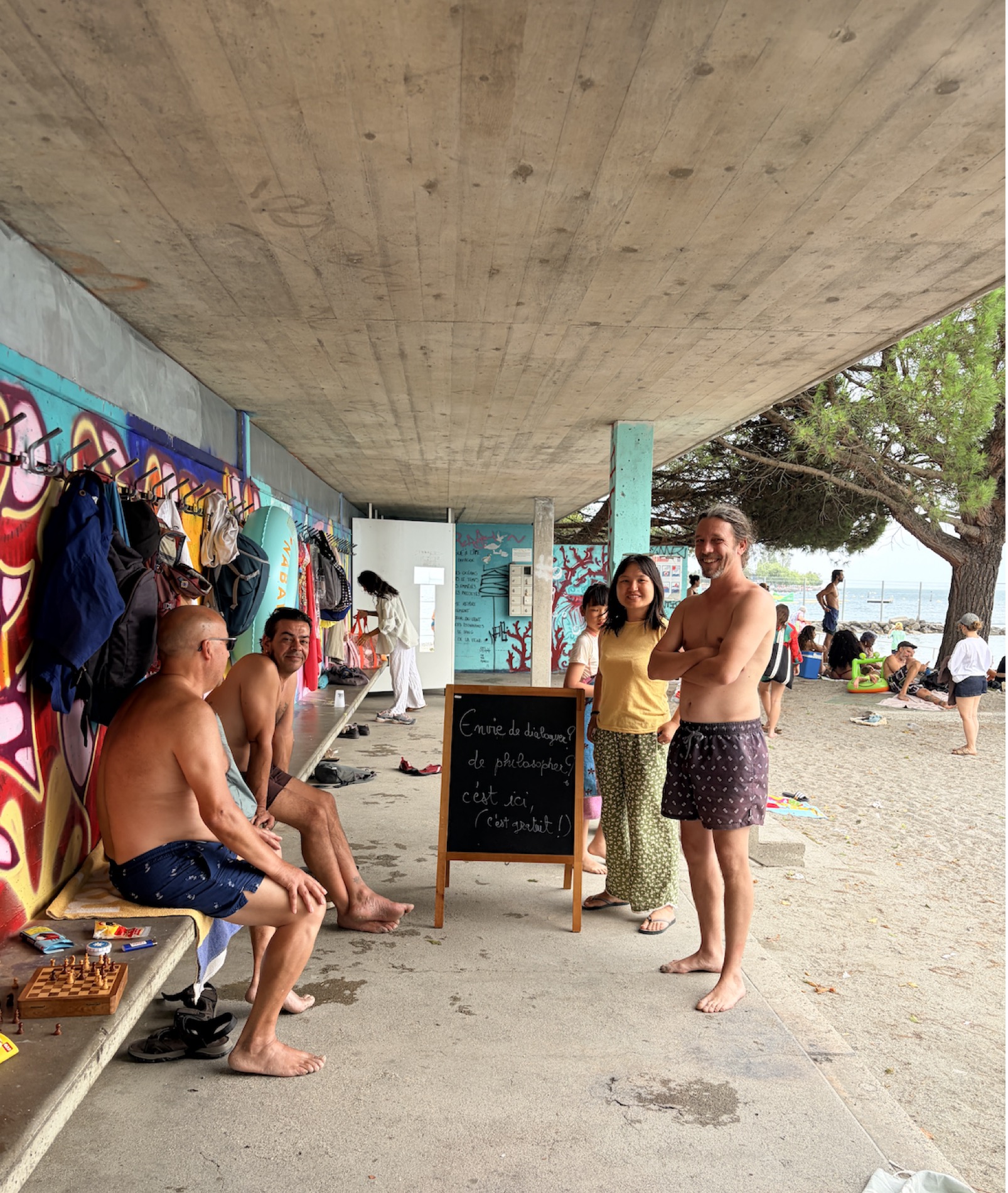
In that privileged setting, between the trees and Lake Geneva, we created a small open-air philosophy lab.
We weren’t offering lessons or a display of knowledge. We started from concrete situations brought by the people we met: a young man who wanted to travel but suspected travel was, for him, a way of running away; a woman who described herself as deeply empathetic; a chess player who realized he panicked at the exact moment he was about to win.
What do we really want? Why do we justify ourselves the moment someone simply points out a behavior? Is empathy always a good thing? Why are some people afraid of succeeding?
Each time, we invited the person to examine their own words.
Wei’s Quiet Tenacity
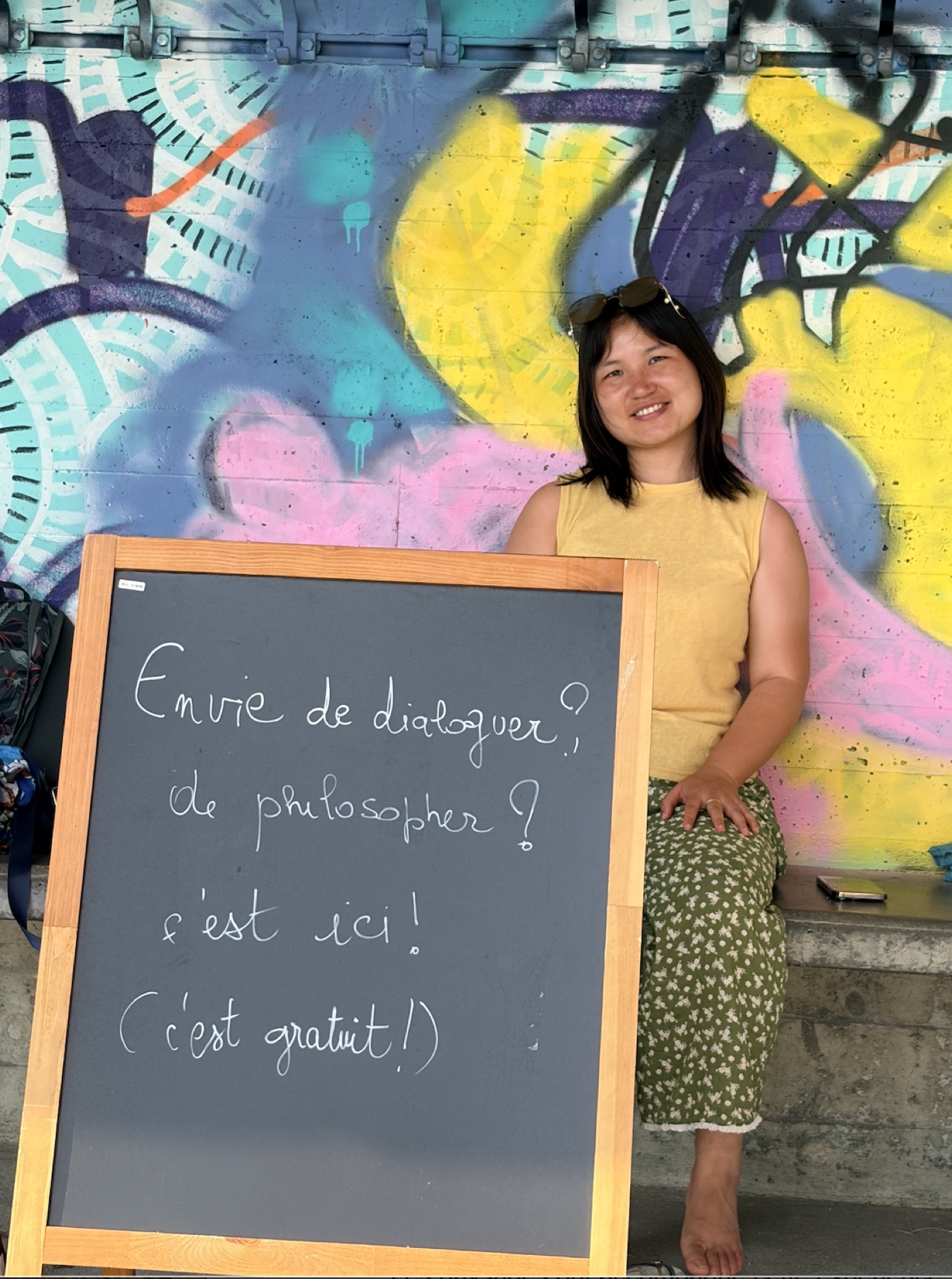
Throughout these encounters, I paid particular attention to Wei’s way of practicing and questioning. What struck me about her could be called a “quiet tenacity.”
Questioning someone takes courage. A question can unsettle, or be taken as an attack. The person being questioned may dodge, shut down, or put up a wall. Out of politeness, or fear of causing offense, we’re tempted to change the subject.
Wei doesn’t give up that easily.
She keeps questioning without aggression. She stays gentle, but she won’t settle for an answer that skirts the issue. She rephrases, looks for another way in, and patiently comes back to the question — as if searching for the key that would open a door.
It sometimes takes several attempts. You have to accept the silences, the resistance, and the possibility of being momentarily misread. Then, little by little, something opens. People start observing themselves differently. They argue instead of just recounting; they turn things into questions instead of defending a single point of view.
Wei’s presence also meant we constantly had to cross the language barrier. Some conversations happened in English, others needed translating. That detour sometimes slowed things down, but it also made us more attentive to the words we were using and to what we actually meant.
What These Journeys Put to the Test
These journeys confirmed for me that philosophizing isn’t just about handling concepts or knowing the great authors. Philosophizing also means approaching someone we know nothing about. It means listening to what they say, but also to what their words might reveal without their knowing it. It means taking the risk of a question that unsettles.
Philosophical practice also transforms the person asking the questions. We had to work on our relationship to refusal, awkwardness, judgment and the unexpected. We were sometimes clumsy. We had moments of doubt, tiredness and waiting. But we also saw strangers stop, smile, think, and consider their own lives from a new angle.
The landscapes were part of the experience too. In front of the mountains, forests and lakes, our problems didn’t disappear — they simply stopped filling the whole horizon. We felt connected to something larger than ourselves.
Putting Philosophy Back Into Circulation
Through the Philomobile journeys, I want to bring philosophy out of the places it’s usually confined to. To put it back into circulation — on the roads, in public squares, on beaches, in villages. To create encounters between people who, otherwise, would probably never have spoken to each other.
The point isn’t to hand citizens ready-made answers, but to build, together with them, a space where a thought can be born.
The Philomobile carries us from one place to another. Philosophy moves us differently: it shakes what we thought we knew about ourselves, about the people close to us, and about the strangers we meet along the way.
Catalina, Corinne and Wei each gave this first journey its own color, its own questions, its own way of being in the world. More journeys will follow, with new people, new landscapes and new encounters.
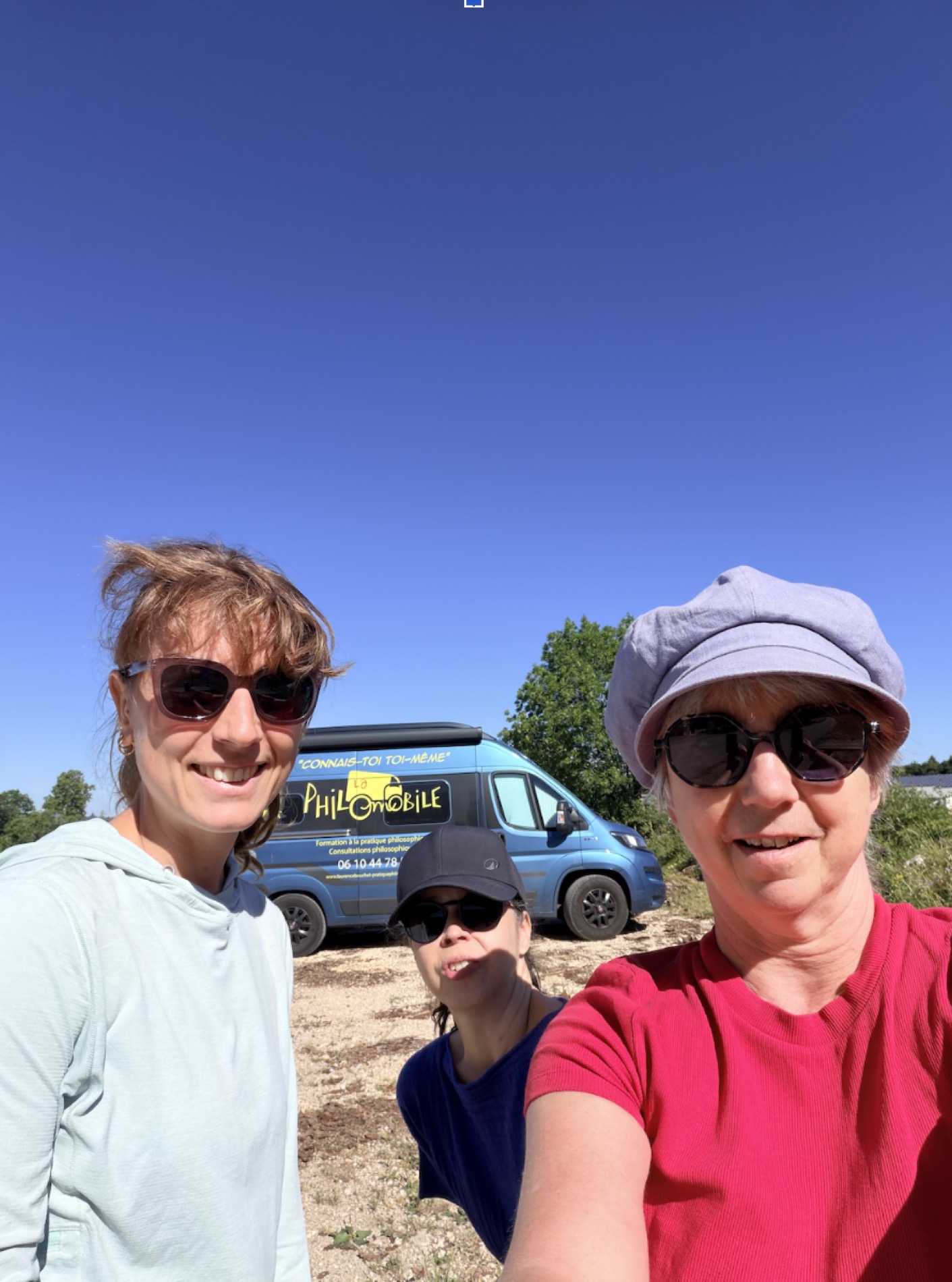
Because philosophizing in the city means accepting that you can’t know in advance what will happen — and that’s exactly why we’ll be back on the road.
CONTINUE THE DIALOGUE
Your reflections on this text
These lines make no claim to definitive truth: they are a proposal to discuss, extend or contradict. Your objections, questions and hypotheses are welcome.