 PhilomobileBy Laurence Bouchet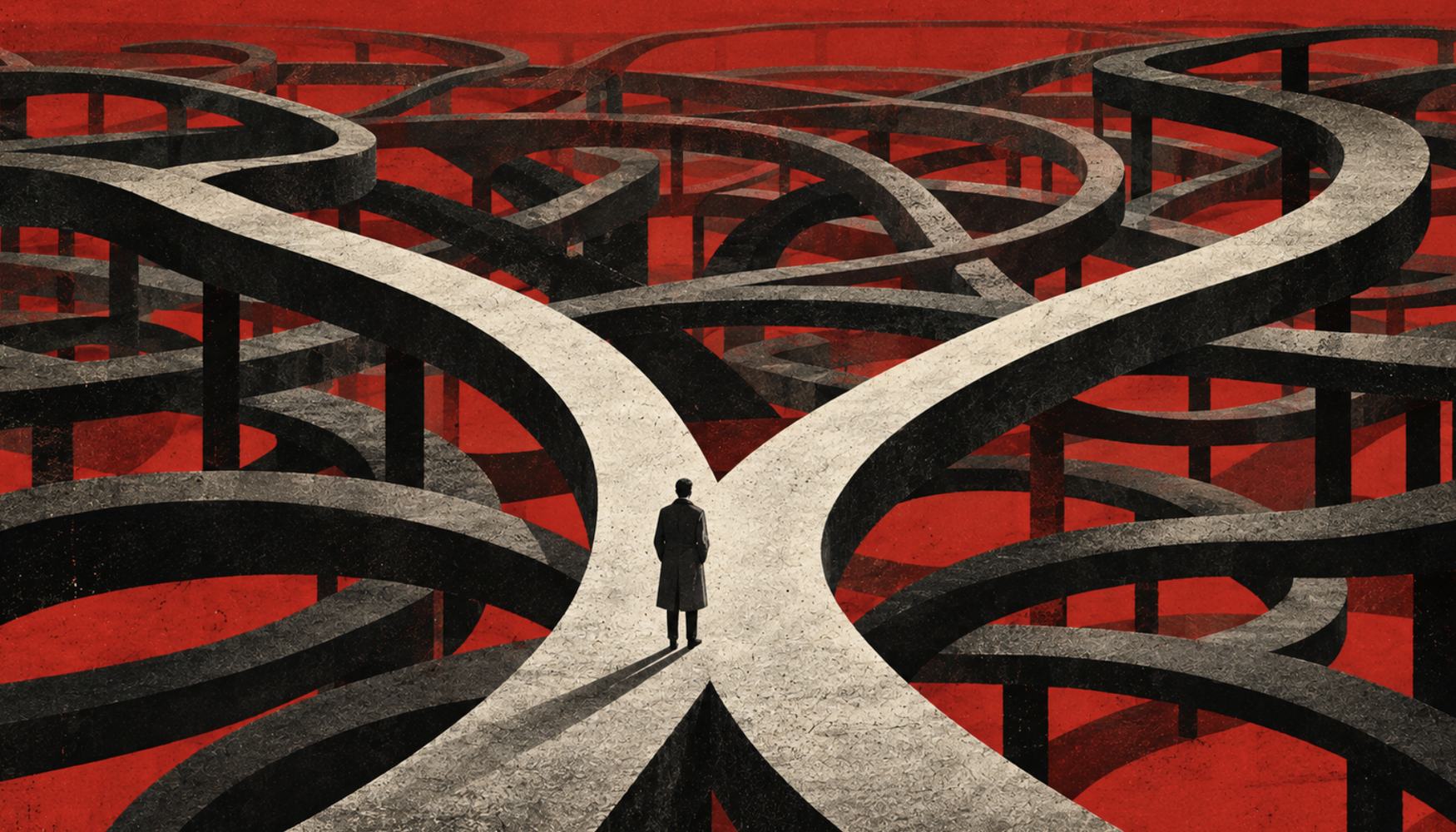
Binary thinking has a bad reputation. Answering yes or no, deciding between true and false, is readily taken to be poor, rigid, almost suspect. We prefer nuance, the plurality of viewpoints and, above all, complexity, a word that has become so familiar that it sometimes serves less to think than to postpone the moment of concluding. The distrust is understandable: reality does not let itself be shut into two boxes. But does it follow from the complexity of reality that our thinking must be complex from the outset?
What I would like to defend here is not the binary for its own sake, but what it serves: determination. To think is also to assert something precise enough to be examined, discussed and, if need be, refuted. The binary is only one of the tools of this demand. It momentarily gives thought a vector: instead of letting it unfold in every possible direction, it imposes an axis along which it has to move forward. This axis makes it possible to see something that would otherwise remain lost in multiplicity.
What the Elenchus Is Accused Of
In my practice, I draw on the Socratic elenchus: a way of questioning that seeks to make a person clarify what they are asserting, to examine the consistency of their propositions and to bring their contradictions to light. The point, then, is not to encourage someone to develop whatever comes to mind, but to invite them to stop on one idea, to formulate it clearly, and then to see how far it holds. This approach is often experienced as a form of violence. When I ask someone to choose between two propositions, to answer before elaborating, or not to shift the question right away, I am sometimes accused of being too binary, of reducing thought or of preventing the person from expressing themselves.
“It Depends”
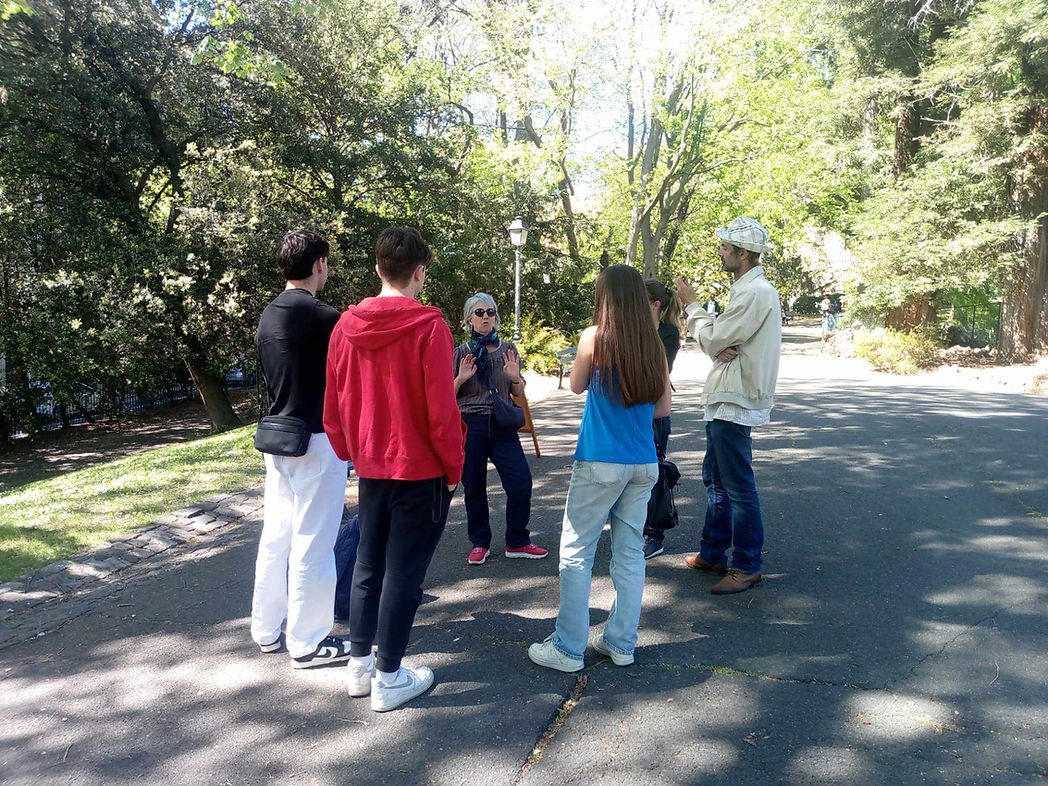
Recently, during a workshop that brought together some twenty people from different backgrounds — teachers, coaches, psychologists, hypnotherapists — I asked this question: who in the room recognizes themselves more in the need to think a great deal, at the risk of not acting? And who plunges into action more easily, at the risk of not thinking enough? One person became sharply irritated, reproaching me for my reductive question and asserting that one could not answer that way, that everything depended on the situation.
On the substance, she was right. No one is all of a piece. One can hesitate for months before changing careers and accept an invitation without giving it a thought. But the question did not ask what each person was in every circumstance; it asked which way each person thought they tended to lean. Relative to that precise question, “it depends” is a true answer, but one that does not answer. Whoever says “more on the side of thinking” exposes themselves: they can be asked in which situations this tendency keeps them from acting, what this caution costs them, and whether they do not sometimes take for reflection what is really fear. Whoever answers only “it depends” avoids this test.
I then wondered whether what bothered people had to do only with the binary nature of the question, or also with the fact that it forced them to acknowledge an unflattering tendency: thinking to the point of not acting, or sometimes acting without having thought enough. Nuance is precious when it corrects an overly crude opposition or introduces a necessary distinction, but it also often becomes a way of putting off the moment when one takes a position, by endlessly adding circumstances, exceptions and reservations. There are thus two uses of nuance: one that makes a thought more precise, and one that ends up making it indeterminate.
Isolating in Order to Examine
The problem is an old one. In Plato’s Protagoras, the sophist has just delivered a long speech in which he shows, among other things, that what is good varies according to beings and circumstances: a given thing is good for man and bad for the plant, good on the outside of the body and bad on the inside. Socrates does not deny this diversity. He simply asks for shorter answers, so as to be able to isolate one proposition and examine it. What he rejects, then, is not the complexity of the content, but a form of discourse in which several ideas follow one another without any one of them being easy to seize and test. Socrates does not simplify reality; he momentarily simplifies the object of the dialogue.
This demand can be compared to the practice of a martial art. A real fight is formidably complex: distance, balance, rhythm, fatigue, footwork, the opponent’s reaction. Yet to learn, one does not begin by reproducing all of that complexity. One isolates a movement, repeats it, seeks its precision, and then learns to link it to the others. The practitioner knows perfectly well that the movement worked on in isolation will probably never present itself in exactly that form in a real situation. That does not make the exercise absurd.
The same goes for thought. A binary question does not claim that human beings fall into two watertight categories. It can provisionally isolate a tendency, an opposition or a problem in order to work on it. Methodological reduction is therefore not ontological reduction: simplifying a problem does not amount to asserting that reality is simple.
When the Binary Becomes a False Dilemma
This does not mean that every alternative is legitimate. Whoever draws the dividing line also carves up the space of what can be thought. If the division is poor, the person may find themselves summoned to choose between two positions, neither of which corresponds to what they believe to be right. The binary then becomes a false dilemma. But refusing the alternative does not exempt one from precision. One has to show what is wrong with the proposed division, explain why the two terms are not mutually exclusive, or formulate another position just as clearly. Saying “this alternative is badly constructed because…” is a thought. Saying only “it’s more complex than that” is not.
Indeterminacy Disguised as Complexity
This is where a certain vulgate of complex thought sometimes seems to me to be a problem. By constantly reminding us that every phenomenon must be placed within a set of relations, it ends up casting suspicion on the very operation of isolating, distinguishing and simplifying. As if every provisional reduction were already a mutilation of reality. But a thought that immediately seeks to connect everything also risks no longer determining anything. To connect, one must still know what one is connecting; to make things complex, one must first have begun by distinguishing.
The problem, then, is not complexity, and still less nuance. The problem is indeterminacy passing itself off as complexity. A rich thought is not one that keeps every possibility open indefinitely; it is a thought capable of determining itself enough to undergo the test of objection. The complexity of reality does not call for confused thinking, but for thinking clear enough to distinguish its different dimensions.
 Philosophical Practice
 Philosophical Practice
 Philosophical Practice
CONTINUE THE DIALOGUE
Your reflections on this text
These lines make no claim to definitive truth: they are a proposal to discuss, extend or contradict. Your objections, questions and hypotheses are welcome.