 PhilomobileBy Laurence Bouchet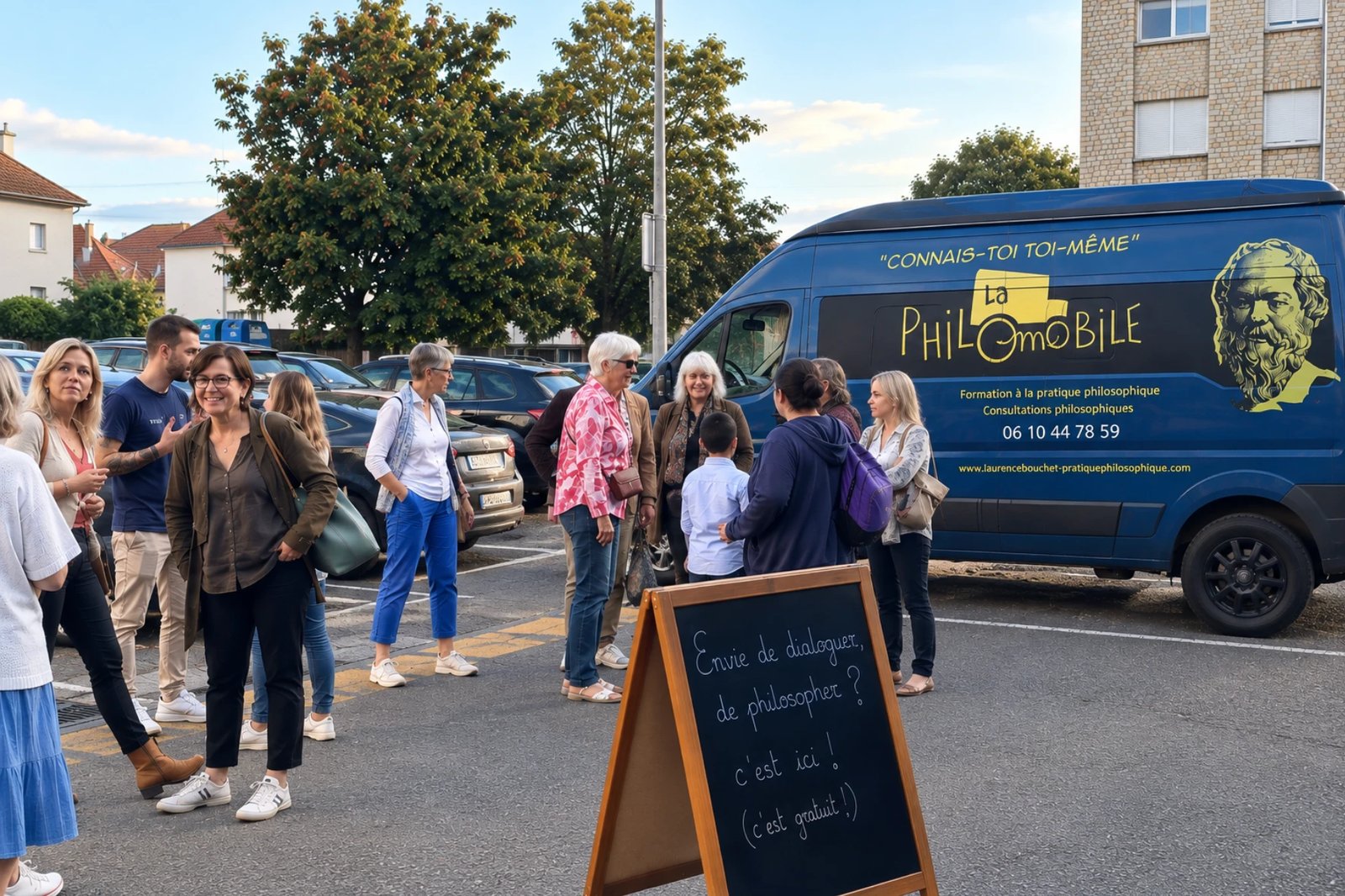
We often speak of “philosophical practice” in the singular, yet it takes very different forms. For several decades now, we have seen a revival of practices that take philosophy out of its usual academic settings. Philosophy has thus appeared in consulting rooms, cafés, primary schools, companies, prisons and public spaces.
All these practices share one conviction: philosophy is not only a matter of knowing doctrines or commenting on authors. It can also be exercised. Questioning, arguing, conceptualizing, examining one’s presuppositions and putting one’s thinking to the test are all ways of philosophizing.
But behind this common claim, significant differences soon appear. How much room should be given to spontaneous speech? Should we seek consensus or, on the contrary, bring disagreements to light? Should the facilitator stay in the background or intervene actively? Does philosophizing mainly consist in allowing everyone to express themselves, or in putting what they think to the test?
The categories that follow are necessarily schematic. Methods overlap, evolve and can be practiced very differently depending on the person. They nevertheless make it possible to distinguish a few broad orientations.
What is philosophical practice?
Philosophical practice refers to a set of approaches that invite each person to philosophize for themselves, rather than remaining a mere spectator of the thought of philosophers.
It is therefore not only a matter of accumulating references, but of exercising certain abilities: questioning, conceptualizing, arguing, problematizing, identifying one’s presuppositions, examining one’s contradictions and stepping back from one’s own way of thinking.
In this, it rediscovers something of ancient philosophy. Pierre Hadot, in particular, showed how inseparable ancient philosophy was from spiritual exercises and from a transformation of one’s way of life. Socrates himself wrote no treatises: he questioned the people he met in the agora.
I have written elsewhere about what distinguishes philosophical practice from academic teaching or from psychology. The aim here is to examine what distinguishes practitioners from one another.
1. Socratic dialogue through questioning: Oscar Brenifier
The principle
Inspired by Socratic maieutics, this approach places rigorous questioning at its center.
The practitioner does not primarily seek to set out a doctrine or give an opinion. He or she asks questions. The practitioner may ask the other person to answer a question precisely, to choose between several hypotheses, to define a term, to justify a statement or to examine a contradiction.
The work bears as much on the content of ideas as on the way of thinking: do we really listen to the question being asked? Do we immediately try to justify ourselves? Do we need to be right? Can we acknowledge a contradiction without immediately trying to make it disappear? Do we find it hard to take a clear position?
Philosophizing thus also becomes an observation of one’s own thinking.
Skills developed
Questioning, deepening, conceptualizing, arguing, problematizing and examining one’s presuppositions.
Formats
Individual consultations, group workshops with adults or children, interventions in companies and schools, training of practitioners.
Key figure
Oscar Brenifier, who holds a doctorate in philosophy, founded the Institut de Pratiques Philosophiques in 1995 with Isabelle Millon. He has trained many practitioners in France and abroad and published numerous books for children and adults alike.
What characterizes this approach
It can be demanding and sometimes uncomfortable. The aim is not for the other person to leave reassured in what they already thought, but that they may discover a contradiction, a confusion or a recurring way of reasoning.
Its advocates regard precisely this discomfort as one of the possible conditions of philosophical work.
2. Philosophy for Children: Matthew Lipman
At the end of the 1960s, the American philosopher Matthew Lipman noticed the reasoning difficulties of his students and hypothesized that thinking should be exercised much earlier.
He then developed the Philosophy for Children program, based in particular on philosophical stories written for children.
After the reading, the pupils themselves formulate the questions they wish to examine.
The heart of the method
The “community of inquiry.”
The group searches together. Each person must listen to the others, take up their proposals, put forward reasons, examine hypotheses and gradually build a shared reflection.
The teacher or facilitator does not hand down a ready-made answer. He or she looks after the process of inquiry and the quality of reasoning.
Key figures
Matthew Lipman and Ann Margaret Sharp, who founded the Institute for the Advancement of Philosophy for Children in the United States in 1974.
The approach has since spread widely around the world.
→ Further reading: Philosophy workshops with children
3. Discussion with a Philosophical Aim (DVP): Michel Tozzi
The Discussion à Visée Philosophique, or DVP (Discussion with a Philosophical Aim), developed in France mainly in the field of education.
It organizes a group discussion around a philosophical question within a structured framework.
Participants may be assigned different roles: chair, reformulator, summarizer, observer. Speaking turns follow rules known to all.
Michel Tozzi identifies three major philosophical skills: problematizing, conceptualizing and arguing.
The DVP thus gives an important place to learning how to debate, to cooperation and to the democratic dimension of discussion.
Key figure
Michel Tozzi, a specialist in the teaching of philosophy at the University of Montpellier, has contributed greatly to the development and spread of “new philosophical practices” in France.
Where is it practiced?
Mainly in schools, but also in associations, libraries and other places of discussion.
4. AGSAS philosophy workshops: Jacques Lévine
This approach, born at the crossroads of psychoanalysis and education, invites children to reflect on a great question about the human condition for a set amount of time.
An important feature is the very discreet role of the adult.
The adult intervenes little in the content of what is said. The aim is notably for children to experience themselves as subjects capable of thinking about the world and of producing speech that deserves to be heard.
Key figure
The psychoanalyst Jacques Lévine and the AGSAS association.
What sets this approach apart
The emphasis is placed more on the emergence of speech and on building oneself as a thinking subject than on rigorously testing arguments.
This difference matters: helping someone become aware that they think is not quite the same as confronting their thinking with its contradictions.
5. Philosophical counseling: Gerd Achenbach, Lou Marinoff
Philosophical counseling is based on a one-to-one setting: a person comes to meet a philosopher in order to examine a question that troubles them.
It may be a choice, a relationship, a conflict, a difficulty in acting, a feeling of being stuck or, more broadly, an existential question.
The philosopher makes no medical diagnosis and does not claim to treat a pathology. The aim is to help the person examine the representations, values and reasoning that shape the way they view the situation.
Key figures
In 1981, the German philosopher Gerd Achenbach opened a Philosophische Praxis (philosophical practice) near Cologne.
In the United States, Lou Marinoff helped popularize the approach in the late 1990s, notably with his book Plato, Not Prozac!
A very diverse practice
The term “philosophical counseling” actually covers very different practices.
Some practitioners favor a relatively free conversation, listening and putting things into perspective through the works of philosophers.
Others, notably in the wake of Oscar Brenifier, use much tighter questioning aimed at directly examining the other person’s way of reasoning.
→ Further reading: Is philosophical practice a form of therapy? · Philosophical consultation
6. Neo-Socratic dialogue: Leonard Nelson and Gustav Heckmann
Neo-Socratic dialogue is a German tradition that emerged in the early 20th century.
A small group usually starts from a concrete example experienced by one of the participants.
From this particular situation, the participants methodically seek to answer a more general question: What is a fair decision? What is trust? When can we speak of responsibility?
The facilitator gives no opinion on the substance. Their role is above all to safeguard the method and the progress of the inquiry.
Key figures
Leonard Nelson, a philosopher in Göttingen, then his student Gustav Heckmann, who did much to formalize the practice.
What sets it apart
Taking time, the careful analysis of an example and the search for agreement among participants.
A neo-Socratic dialogue can thus last several hours, or even several days.
7. Philosophy cafés: Marc Sautet
The philosophy café rests on a simple idea: philosophizing in a public place open to all, with no particular prerequisite.
A facilitator proposes or collects a question, and the discussion begins among those present.
Key figure
In 1992, Marc Sautet launched a philosophy café at the Café des Phares, on the Place de la Bastille in Paris. He recounts the experience in Un café pour Socrate.
The movement then spread widely in France and in other countries.
A wide variety of practices
The philosophy café is often a gateway to philosophy outside the university setting.
But everything depends on how it is facilitated.
A discussion in which everyone states their opinion in turn is not necessarily philosophical work yet. For thinking to take shape, one must also be able to ask for reasons, define the concepts being used, examine disagreements and accept that one’s own statements be questioned.
This distinction seems essential to me.
What these practices share
Despite their differences, these approaches share several convictions:
- anyone can philosophize, not only specialists;
- philosophy is an activity as much as a body of knowledge;
- thinking can be learned and exercised;
- engaging with other people can contribute to this exercise.
But behind this general agreement lie rather different conceptions of what philosophizing means.
What divides them
A first difference concerns the role of the facilitator.
The facilitator may stay very much in the background, as in some AGSAS practices or in neo-Socratic dialogue.
They may mainly guarantee a framework for discussion, as in some DVPs.
Finally, they may intervene very actively in the other person’s thinking through their questions, as in the practice developed by Oscar Brenifier.
A second difference concerns the purpose of the practice.
Some approaches seek above all to help a person realize that they are capable of thinking and of making their voice heard.
Others focus on learning collective or democratic discussion.
Others still seek to transform the relationship each person has with their own thinking.
But an opposition runs perhaps even deeper through these practices: is it enough to allow a thought to be expressed, or must it also be put to the test?
Expressing an idea can be important. But philosophizing perhaps truly begins when that idea itself becomes an object of examination.
- Why do I think this?
- What am I presupposing?
- Is my statement consistent with what I have just said?
- Am I able to seriously consider the opposite hypothesis?
- What happens when someone challenges my idea?
These approaches therefore do not pursue exactly the same aims, nor do they place the same demands behind the word “philosophizing.”
Their diversity ultimately leads to a question more interesting than which method would be “the right one”: at what point does a discussion become truly philosophical?
My practice
I was a philosophy teacher before becoming a practitioner.
My studies opened my mind and allowed me to encounter ideas that have mattered deeply to me. But they also taught me, at times, to admire great discourses more than to examine my own thinking. They also fostered in me a certain inhibition: the great philosophers had thought before me and better than me. What could I still think for myself?
Meeting Oscar Brenifier and his way of practicing questioning was a turning point.
I discovered a philosophy in which it was no longer mainly a matter of commenting on what others had thought, but of taking the risk of examining what I myself thought.
I therefore clearly place myself within this tradition of Socratic questioning.
When I lead a workshop or a consultation, my first aim is not to pass on my ideas, nor for everyone to leave reassured in their own.
I ask questions so that the person can see more clearly what they think, what their statements presuppose and the mechanisms that shape their way of reasoning.
This may mean accepting being interrupted, answering a question precisely, choosing when one would rather keep several options open, or acknowledging a contradiction.
This work is therefore not only about ideas.
It is also about our attitudes: the way we listen, react to an objection, justify ourselves, try to convince, protect ourselves when a question puts us in difficulty.
Philosophizing then also means learning to watch oneself think.
This connection with Oscar Brenifier does not mean, however, that I adopt all of his methods.
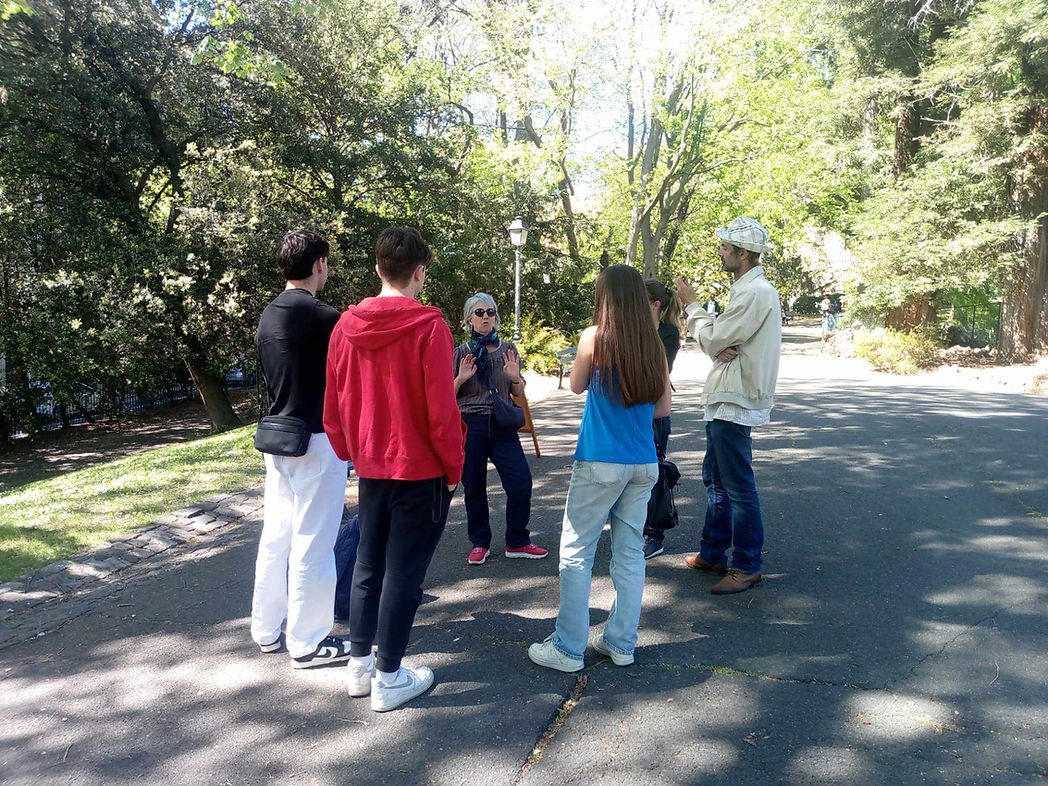
Since 2013, I have chosen to philosophize in the city, with very different audiences: children at school, secondary school pupils, prisoners, apprentices, people with disabilities, employees in companies or simply passers-by.
I also created the Philomobile, a van fitted out as a space for dialogue, in order to philosophize in public spaces with people who would probably never have walked through the door of a philosophy workshop.
With a team, we traveled across France all the way to Morocco.
These experiences gradually convinced me of one thing: the ability to think is not reserved for those who have studied philosophy. But neither does it develop simply because people are given the floor. It needs to be exercised.
Today, I offer individual philosophical consultations, workshops and courses, and I also train people who wish to learn how to lead philosophical dialogues.
I work with other practitioners trained in this method.
→ Training in philosophical practice
Frequently asked questions
The academic teaching of philosophy gives an important place to works, concepts, philosophical problems and the history of ideas.
Philosophical practice puts the direct exercise of the participant’s thinking in the foreground.
It is not simply a matter of understanding what Plato, Spinoza or Nietzsche thought, but of examining what we ourselves think and how we think it.
The two approaches can, of course, nourish each other.
No, even though it can have beneficial effects.
It does not diagnose or treat a pathology. Its primary object is thinking: examining our representations, our reasoning, our values and the way we interpret the situations we experience.
I have devoted an article to this question: Is philosophical practice a form of therapy?
No.
No particular prerequisite is needed, since the starting point is precisely what the person already thinks.
The difficulty does not necessarily lie in having a great deal of knowledge. It often lies in accepting to truly examine what one asserts.
Many organizations and practitioners now offer training, based on different methods and conceptions of philosophical practice.
For my part, I offer training centered on Socratic questioning: learning to ask questions, identifying presuppositions and contradictions, working on attitudes of thought and gradually leading a person to examine their own way of reasoning. Individual training is available in English; group training is taught in French.
 Philosophical Practice
 Philosophical Practice
 Philosophical Practice
CONTINUE THE DIALOGUE
Your reflections on this text
These lines make no claim to definitive truth: they are a proposal to discuss, extend or contradict. Your objections, questions and hypotheses are welcome.